
Written in partnership with You Need a Budget

How it began …
I’m staring at a 311-word support response from You Need a Budget’s (YNAB) customer support specialist, Becki. I assume I’m about to read a soulless, emotionless response copied and pasted from a knowledge base article, yet, it’s anything but.
Instead, I find a beautifully personalized response with snippets of text explaining the solution.
With SaaS being a heavily saturated market, every year is an opportunity for your customer to question whether your service is actually adding value - and the answer had better be yes, or your ship might sink faster than you can correct course.
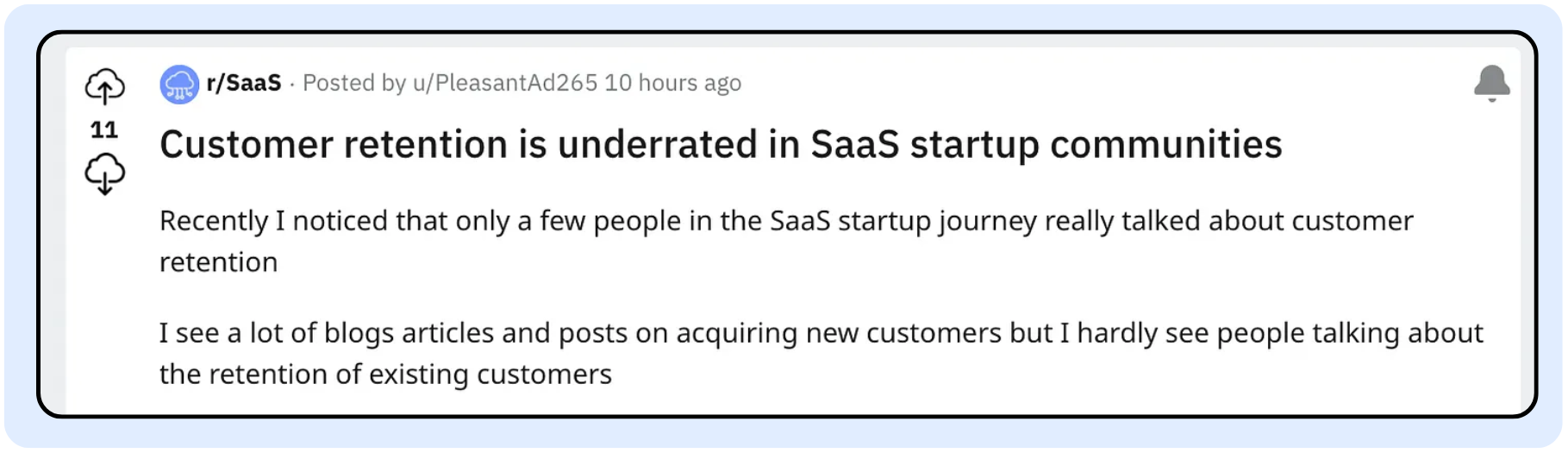
But just as one Reddit user pointed out, ‘growth’ trumps ‘retention’ in SaaS discussions around the web:
So, in the spirit of learning from the best, I interviewed YNAB’s Director of Customer Support - Angela, to find out how they champion customer support and how you can turn customer support into your competitive edge.

Angela, Director of Customer Support - YNAB
1. Customize your language
Language can have a powerful effect both on ourselves and the people to whom we’re speaking. YNAB recognized that.
YNAB’s approach:
Years ago, YNAB transitioned the support language they used by referring to “tickets” or “issues” as “conversations” - a tip they picked up from their partner, Help Scout.
“This might sound a little weird, but calling something a “ticket,” I think is a really big negative.” - Angela
By transitioning from tickets/issues to conversations, YNAB changed the way support specialists approached a request. Instead of considering it a “ticket to solve,” it was now a conversation between friends in which one friend helps find the solution for the other.
Your turn:
Angela noted that many SaaS tools offer support through Zendesk where it’s not easy to modify the system’s labels or language. But wherever possible, both in written correspondence and to the extent your support platform will allow, consider choosing alternate terms for your support jargon that reframe the context of your support discussions in a positive light.
Here’s a starting point of changes to get you and your team off to the races:
“Tickets” 👉 “conversations.”
“Rep” 👉 “specialist”. YNAB believes the “specialist” title more accurately conveys the expertise their team members need to do their job well.
“QA” 👉 “conversation review” reduces potential confusion with QA for the engineering team.
2. Establish a trial period
If you’re a small SaaS, then an all-hands-on-deck approach to customer support might cut it for now, but as you grow, you’ll inevitably receive a growing frequency of support requests and an ever-growing need to expand your support team and output.
YNAB’s approach:
Back in 2015, YNAB’s support team was small, comprised of just four part-timers without a clear support structure, documentation, or process. After transitioning from a traditional software model to software-as-a-service, the support team quickly received 5,500 conversations into their queue.
“... that was not a period of time I ever want to live through again. And then we started to realize, obviously, that we needed to grow the team.” - Angela
With an immediate need to quickly expand the support team, YNAB began hiring support specialists under a trial period so that they could speed up the process of getting people started answering emails.
Angela explained this well …
“We do get people into the queue on their first day, but that’s not specific to the trial period. The biggest thing we did was eliminate one round of interviews, and we added a hard stop at 8 weeks where we and the new person would reevaluate whether this was a good fit. If at any point during the 8 weeks we didn’t think it was working, we would let the person go then. We honestly haven’t had to do that very often, but it’s nice to have that option.“
Your turn:
Consider adding a trial period for new hires that includes an 8-week hard stop for both yourself and your new support specialist to evaluate whether they’re a good fit for their new role.
3. Hire support specialists who match your core values
Your support team is customer-facing, representing your company at some of the most crucial moments when your users might be feeling frustrated or confused. Bringing on support specialists who align with your company’s core values is crucial to ensure your support specialists are providing the exact attention and care to your users as you’d expect.
“The biggest thing we look for in hiring is a core value fit. I don't know if you've read any of our job postings or our cultural manifesto. But we always look for core values, especially in support.” - Angela
You Need a Budget first establishes a good core value fit with a potential hire and only then brings them on board to move through their training processes.

The YNAB team at their 2019 Laguna Beach company retreat
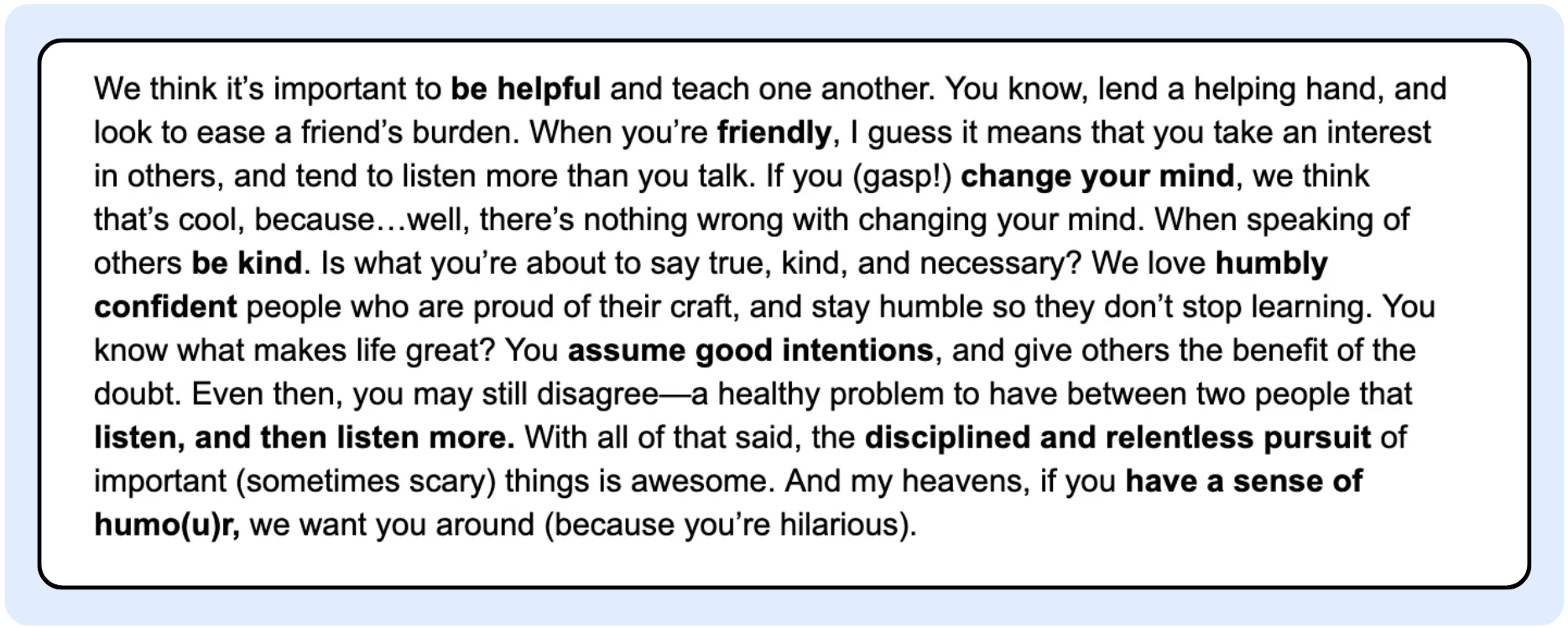
For reference, here’s a look at YNAB’s cultural manifesto. It both exudes their brand voice and elegantly outlines the core values they look for in new hires. Plus, it can be conveniently accessed from the Careers page.
Your turn:
Decide on your company’s core values. Consider writing them out clearly and making them accessible to potential hires to peruse before applying. After all, a potential hire might not be on board with your values, and it’s better for both you and them to figure that out before spending time and resources on them.
4. Solve for specialist’s pain points
Although each software and solution is different and requires varying amounts of time for a support specialist to master, YNAB’s support specialists are often surprised to learn it takes about a year to get fully up to speed with providing support.
With nearly a year-long investment into the success of each support specialist, retaining team members is extremely important to prevent additional time and financial costs of routinely replacing team members who leave.
A large part of YNAB’s retention strategy for support specialists is to identify team members’ pain points and then routinely implement internal changes that solve these pains, ultimately contributing to the staying power of their team members.
Your turn:
Identify any pain points/themes your support specialists consistently experience and implement a plan of changes to solve or relieve those pains for your team members.
5. Focus on your best support channel
From email and chat to phone support and screen sharing, there’s a handful of support channels to offer your users, and knowing whether you should focus on one or offer them all can be tough.
Phone support provides the fastest solutions, but with each support channel requiring different technical capabilities and levels of work to conduct and maintain, your best choice is to focus on the channel of support you’re best at delivering.
YNAB is particularly effective at email support because they’ve been doing it for so long and have learned a lot of strategies to provide it effectively.
But if you’re wondering which support channel might be best in the future, YNAB predicts that live chats will replace email, especially when supported with a remote connection and live screen-sharing capabilities:
“The thing that we think is most impactful or could be the best support experience would be something like a live screen share, which we don't offer yet. But we try to approximate that.” - Angela
Your turn:
Determine which support channel you can deliver most effectively, then double down on providing the best experience for your users within that channel. You can expand to other channels later as your resources grow.
6. Measure the right customer success metrics
Claire Suellentrop, co-founder of Forget the Funnel, wrote that it’s common for customer support teams to optimize for the wrong success metric, e.g., “number of tickets closed.” This motivates the customer support team to prioritize speed over quality of response.
While YNAB’s support metrics evolve, one thing stays the same: hiring people who align with your values and genuinely want to help does more for user satisfaction than pushing specialists to close cases quickly.
“My first answer to this is - It's the people that you hire. But even if I were to say, you [YNAB support specialists] will be penalized or rewarded for going slow or fast, our team members could not help but be helpful. It’s just innate in them.
Angela referenced The Effortless Experience by Mathew Dixon and Nick Toman, which explains that delight is not an indicator of customer loyalty but rather how easy it was for them to get their issue solved.
But this doesn’t mean you shouldn’t track any metrics … YNAB still tracks common customer support metrics such as:
Total number of conversations
Rate of replies to resolve
Conversation categories (and whether they line up with how their support team is segmented)
Amount of support outside the queue
But all of these metrics are used not to determine the effectiveness or quality of their support team but often point towards a hiring issue or assist in solving for other internal efficiencies.
Core value metrics:
YNAB keeps their core values top of mind in quarterly review meetings. Most importantly, the magic comes from managers and specialists reflecting on how their work is going together and making a plan for the future.
“So every quarter, they kind of talk through with their manager. Here's how I'm feeling on all our core values. Here's where I think I could do better. Here's where I've really aced it this last quarter. And then they set a focus for the next quarter.” - Angela
In addition, quarterly meetings are particularly effective at uncovering some of the pain points the specialists are facing. These pain points are then discussed in weekly manager meetings.
Managers might see the same root issue crop up over multiple months, indicating a systemic issue that might need a more holistic solution rather than a quick band-aid fix.
Additionally, managers send out a survey every fall to measure team connectivity and engagement. A few of their most effective questions that get good results are:
If you could change one thing about support at YNAB, what would it be?
Did you feel overworked, underworked, or just right this quarter?
What could I do as your manager to make your workdays more pleasant and make it easier to reach your goals?
Note: Angela noted that unless you’ve established a culture of trust where team members know they won’t be penalized for sharing honestly, these types of questions won’t work.
Support queue metrics:
YNAB reviews support conversations internally because even when customers rate the experience highly, responses may miss the mark on tone or fail to address the root issue. For example, offering a trial extension might seem helpful, but if the real problem was confusion about using the product, the core issue remains unsolved.
Your turn:
Hire support team members who align with your core values, not just those who can hit metrics like "tickets closed." This ensures they deliver thoughtful, high-quality help to customers.
For more on reducing friction and boosting loyalty, check out The Effortless Experience and its insights on customer effort scores.
7. Segment your support
You’ll start to notice recurring support themes. When certain issues require deeper expertise, it’s smart to delegate them to team members who specialize in those areas.
YNAB’s angle:
One thing You Need a Budget swore they’d never do, but later worked well for them was segment their support team into specialized roles.
“For a really long time, everybody had to know everything or at least be able to find everything. And we were really proud of that. We were like, we are a team of generalists. And then we started hearing this theme of I'm overwhelmed, I can't keep up with it all, it's too much. And we thought, “Okay, we need to start moving towards a specialization.” And so we created a team for user accounts and a team for bank connections. And the immediate wins that we saw from that totally convinced us that we needed to move further along the spectrum towards specialization.”
But what were those immediate wins?
By splitting their general support team into specialized groups, YNAB quickly uncovered conversation patterns—like recurring account issues—that had been hidden before. This let the engineering team fix problems more efficiently.
Specialists also felt less stressed, knowing they could pass tricky cases to the right experts. As a result, many issues now get resolved faster and with less effort from users, since the “bugs team” knows exactly which fixes to try first.
While larger teams may not specialize, for a complex product like YNAB, this shift was a big win.
Your turn:
YNAB identified “user account” and “bank connections” as their top support topics and created specialized roles to handle each.
Review your own support requests, pinpoint the top 1–3 recurring themes, and consider assigning them to team members trained to handle those specific issues.
8. Combine personalization and canned texts
Customers don’t value copy-pasted knowledge base replies—they could’ve found those themselves.
While knowledge base articles are great for detailed solutions, they often miss the nuance of a user’s unique situation—and they’re not exactly personal.
That’s where canned texts help. When used well, they let support specialists personalize responses without relying solely on memory.
The key is finding the right balance between efficiency and genuine, tailored support.
“One thing we try to be really intentional about is that a snippet should never be a complete answer, so if you pasted a snippet into your reply and sent it, it would be weird for anyone reading it. That forces personalization to happen.” - Angela
YNAB support specialists use snippets in nearly every reply in order to give really detailed responses, right down to telling users how to do a screenshot.
Your turn:
Use canned texts to ensure accuracy, but always personalize your responses to truly address the user’s issue.
It’s fine to link to a knowledge base article, but make sure the answer is clear in your message—don’t make users hunt for the solution.
9. Run canned texts through Hemmingway
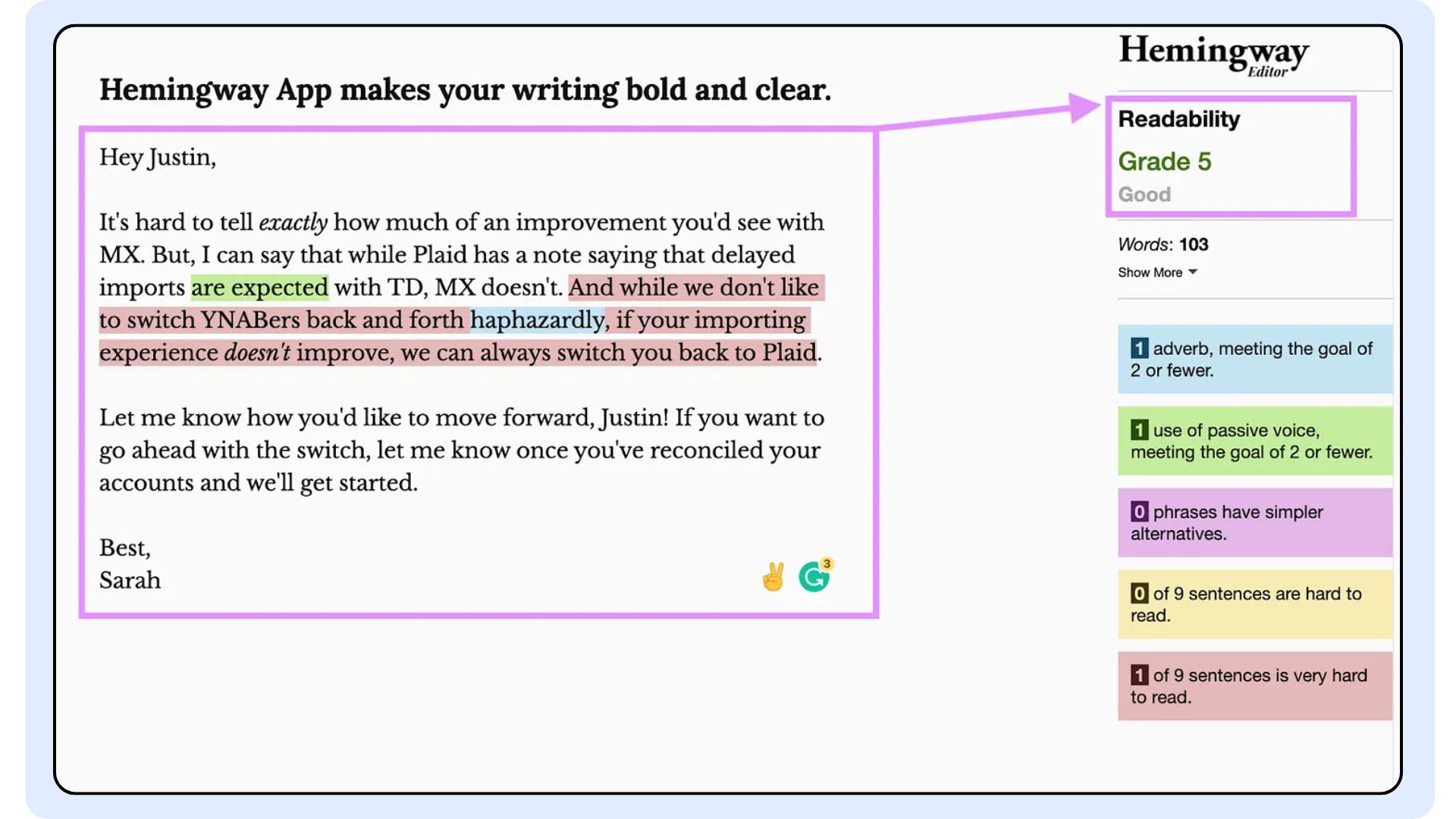
Overly complex support replies often create more confusion than clarity. Aim to write at a grade 5 reading level or lower for support responses, knowledge base articles, and even marketing copy.
The free Hemingway Editor tool is great to help with this.
Here’s an example from YNAB’s support team where Sarah kept things simple, clear, and easy to understand—while hitting that ideal reading level.
Your turn:
You don’t need to run every support reply through Hemingway, but do run your canned texts, knowledge base articles, and other customer-facing copy through it. Then, tweak as needed to keep things clear and easy to read.
10. View support as your competitive advantage
Hiring and training support specialists to deliver personalized service isn’t cheap.
With some SaaS tools charging $1,000+ per month, it’s clear why their support is top-notch. But at YNAB’s average price of under $10/month, I wanted to understand how they manage such great support.
Since Angela’s explanation is spot-on, I’ll let her share the answer:
“We have decided that support is a competitive advantage for us. And so regardless of whether or not the numbers make sense, we've decided that this is something our competitors can't copy. And we're really good at it. And so we will invest in it. It's part of our product in a way.” - Angela
At YNAB, their team members are their biggest investment. When you treat your team members really well, that pays off in word of mouth.
Your turn:
With customers able to switch tools easily, see customer support as a competitive advantage—not just a cost or reactive fix.
Investing in your support team turns those reaching out into loyal, satisfied customers.
Bonus: Set up your support toolbox
You likely already have the tech stack in place to knock customer support out of the park, but if you’re a new SaaS and don’t want to waste time testing different support tools, then YNAB has generously shared the five main tools they use to champion customer success.
You can thank me You Need A Budget later ❤️
YNAB’s Support Stack:
Help Scout: Help Scout provides an easy, powerful way to chat with your customers. YNAB uses Help Scout for having conversations with users and for its external knowledge base.
Guru: Guru provides everything your customer support team needs to solve problems, upsell, and create the amazing experiences that keep your customers coming back for more. YNAB uses Guru internally (and loves it!).
15Five: The YNAB support team uses 15Five for weekly check-ins and 1:1 agendas. That allows them to keep a pulse on how the team is feeling on a given week.
CloudApp: You Need A Budget uses CloudApp for screenshots and videos they send to users. They have password-protection abilities and the ability to auto-expire everything after a certain amount of time.
Wrap up
Customer support is a powerful yet often overlooked growth tool in SaaS. Done poorly, it drives users away faster than you can recover. Done well, it becomes your competitive edge—reducing churn, boosting your reputation, and helping your service stand out in a crowded market.
Your turn:
In case you weren’t taking notes, I’ve put your “next steps” into a convenient step-by-step to-do list:
Reframe your support jargon into positive, solution-focused language
Establish a trial period for new support specialists to ensure the role is a great fit for both you and them
Bring on new support specialists who match your core values
Solve first for your support specialists’ pain points
Focus on your best support channel
Set the right customer metrics for evaluating the quality of your support and your specialists’ well-being
Segment your support team based on recurring customer issues
Use a combination of personalization messages and canned texts to deliver timely, but quality, responses
Run your canned texts through Hemmingway to make sure they’re easy to read.
Start viewing customer support as your competitive advantage that no one else can copy
Special considerations:
I’d like to thank Angela and the entire YNAB team for the opportunity to connect, discuss and provide unique insight into what is one of the most underrated topics in the SaaS community—increasing retention by championing customer support.
What’s next?
Whether you’re looking to gain total control over your finances or would just like to test drive You Need a Budget’s VIP-customer support experience, you can sign up for your very own 34-day free trial below:
Note: The link to YNAB provided is an affiliate link and earns both you and myself an extra free month of YNAB. It does not increase the cost that you pay, but it does support me in creating more useful, free content like this article for you.

Thanks for reading Justin Hammond! Subscribe for free to receive new posts and support my work.
Share this post